
Guides · Fabric and AI
Microsoft Fabric and AI: what is the platform, and when does it make sense?
Sales data lives in an ERP, forecasts in Excel, project information on SharePoint and reports in Power BI. Each component works, but a shared business picture still requires exports, agreed definitions and explanations for discrepancies. Is Microsoft Fabric another database, an expanded Power BI, or a foundation for AI? This guide explains the differences and how to assess the investment.
What is Microsoft Fabric?
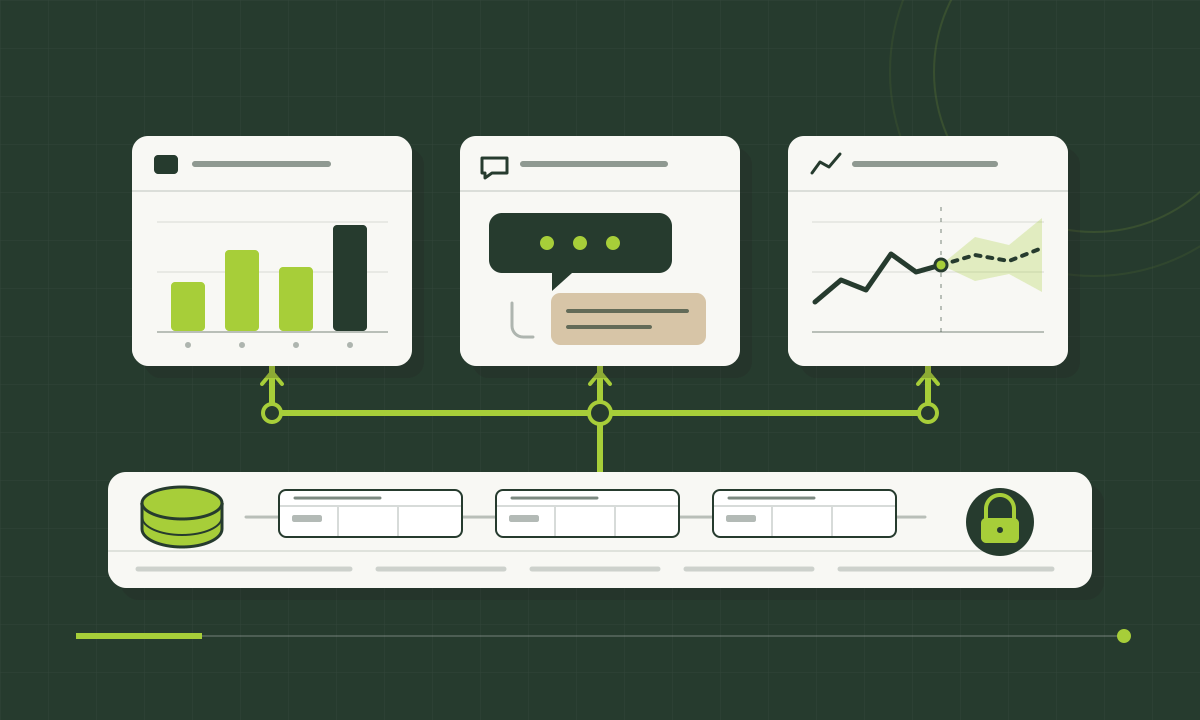
Microsoft Fabric is a platform for working with data, from ingestion and preparation to analysis and reporting. OneLake provides a shared logical data lake for storage and access across the platform's workloads.
The main concepts are easier to understand through their role in a solution than through a product list. The table is a simplified map, not an architecture blueprint suitable for every organisation.
| Component | What does it do in practice? |
|---|---|
| Data Factory | Ingests and prepares data and coordinates processing steps. |
| Lakehouse and Warehouse | Store and organise data; the choice depends on architecture and how the team works. |
| Power BI | Analytical models, business measures and presentation of results. |
| Data Science | Develops and applies machine learning models. |
How is Fabric different from Power BI on its own?
Power BI can operate without an organisation adopting the whole Fabric platform. If a business has a few well-prepared sources and mainly needs a clear report, expanding the environment does not have to be the first step.
Consider Fabric when the problem starts before the report screen. The project then concerns how to deliver trusted data to several use cases, rather than how to build one dashboard.
- Several teams independently extract and transform the same data.
- Manual exports have become part of a critical business process.
- Shared history, quality checks and ownership of errors are needed.
- Reporting and AI solutions need to use the same reconciled information.
Copilot: assistance with preparing and analysing data
AI in Fabric covers different use cases that should be separated before discussing implementation. One is assistance for specialists: Copilot can help with queries, data-processing code and explanations. Its scope varies by Fabric workload.
This supports the author; it does not certify the result. Our recommendation is to review generated code for logic, security and requirements, then test it against cases with known results. Successful execution alone is not an acceptance test.
In Power BI, Copilot can also help analyse and summarise reports. Model preparation and business context affect interpretation. Before a pilot, clarify names, relationships and measures rather than expecting a natural-language question to resolve ambiguities.
Data agents: questions about a selected information scope
Fabric data agents query selected warehouses, lakehouse tables and Power BI models, among other sources. Authors define sources and instructions; sharing grants no additional data permissions. As of 2 November 2026, the agent is generally available; selected Purview extensions remain in preview.
Do not treat it as a universal chat interface for every company document. Start by identifying the questions people need to answer and the prepared data that should support those answers.
- Read-only: it does not update data.
- English is the officially supported language.
- It does not directly read PDF, DOCX or TXT files.
- Lakehouse CSV and JSON files must be exposed as tables.
Predictive models: looking ahead rather than describing history
Machine learning is a separate AI use case, for example for demand forecasting or detecting unusual events. Fabric Data Science provides tools for data preparation, experimentation, model training and bringing predictions into reports.
That does not mean enabling one feature produces an accurate forecast. We recommend agreeing on the objective, error measure and comparison with a simpler baseline. If a model does not improve decisions over the current approach, complexity alone does not justify operating it.
For example, evaluate a demand forecast on periods that were not used in training, reflecting the planning horizon and information available at the time. After launch, someone must own quality reviews and responses to changing business conditions. These are project recommendations, not promises about a particular model's performance.
Why does data preparation matter more than the chat interface?
Imagine a question about last month's margin. A fluent answer becomes useful only when its meaning is clear and the result can be checked against an approved report. A language model should not be left to decide the company's margin calculation rules.
In our approach, AI-ready data is more than technically accessible data. It has agreed meaning, freshness expectations, ownership and access rules. Definitions and test examples are part of the solution, not documentation to add after the pilot.
- What does margin mean, and which costs does it include?
- Is the month closed, and which date determines when a document is recognised?
- How are adjustments and late postings handled?
- Have all required sources been loaded?
- Which currencies and exchange rates apply?
- What data can the person asking see, and who approves the result?
Example: a shared reporting and analysis process
Consider an illustrative scenario, not a named customer or an implementation reference. A company combines sales from its ERP, costs from its finance system and forecasts from Excel files. Each source has an owner and an agreed reporting period; similar column names alone do not make datasets comparable.
The first stage is repeatable ingestion. The process then checks file completeness, product codes, duplicates and comparable periods. Only then is a model built with agreed measures, while the report presents results and exceptions that need explanation.
An AI layer can follow for analysis within a selected scope. Compare representative questions with approved answers, including tests for different audiences. There are two separate success criteria: whether the data is correct and whether AI uses it correctly. A reconciled report does not automatically validate every agent response.
| Stage | What is checked? | Condition for proceeding |
|---|---|---|
| Ingestion | Sales, costs and forecasts for agreed periods. | Completeness of required sources is confirmed. |
| Reconciliation | Duplicates, codes, adjustments and differences from sources. | Differences are explained or publication is explicitly blocked. |
| Model and report | Margin definition, filters, freshness and data visibility. | Results are accepted by the business owner. |
| AI pilot | Questions with known answers and access scenarios. | Response quality is documented and exceptions are handled. |
Licensing and cost: what should you check first?
Copilot requirements were checked on 2 November 2026. Power BI Pro or Premium Per User alone is insufficient. You need suitable paid Fabric F2 or higher capacity, or Power BI Premium P1 or higher, a supported region, tenant configuration and access. Trial capacity does not provide Copilot.
F2 is an eligibility threshold, not a sizing recommendation for every company. Copilot consumes capacity resources. A pilot should therefore assess load and the impact on other processes, not just the appeal of its answers.
For each selected feature, recheck the documentation, GA or preview status and scenario-specific requirements. Include data-processing rules, the intended audience and cost ownership in the project assessment. This guide does not replace an individual licensing or capacity assessment.
Where should you start without migrating the entire business?
Start with one bounded process. Identify the audience, problem and measurable success criteria, then examine the data and ownership. Use that assessment to choose the architecture and AI feature rather than beginning by enabling the whole platform.
Record refusals, ambiguous questions and errors as well as good answers during the pilot. For financial or workforce information, define an escalation route to someone who can confirm the interpretation. Users should know when they are reading an approved report and when they are reading a generated response.
Fabric can give reporting and AI a shared data foundation. Its value depends on whether the business gets trustworthy information sooner and can safely operate the entire process after the pilot ends.
Fabric and AI pilot preparation checklist
- Choose one business problem, the audience and success criteria.
- Agree on sources, measure definitions and completeness requirements.
- Prepare a repeatable data flow and exception handling.
- Assign owners for data, permissions, cost and operations.
- Test access using the actual roles of intended consumers.
- Select one AI use case and questions with expected answers.
- Check current licensing, region and selected feature status.
- Evaluate response quality, load and effects on other processes.
- Document acceptance criteria, error escalation and pilot exit conditions.
Keep the checklist by printing this guide to PDF from your browser.
Questions and answers
Does adopting Fabric require moving the entire ERP?
That is not the objective of the approach described here. Start with a bounded analytical process and the data it needs. The ERP can remain the operational system; how to integrate it requires a separate assessment.
Will AI determine the correct margin definition on its own?
The solution should not rely on that. A business owner needs to approve the definition, cost and adjustment rules, and reference results. Natural-language questions do not replace agreement on these rules.
How do we know a pilot is ready for wider use?
We recommend documented test results, verified access roles, known limitations, a cost assessment and an operations owner. There is no universal accuracy threshold: acceptance criteria depend on the risk of the decisions and the scope of the use case.
Do we need a custom machine learning model immediately?
No. First establish whether the problem concerns data quality, reporting, access to information or genuinely predicting future outcomes. An agreed measure definition and a trusted report are often the more valuable first result.
Documentation and further reading
- Microsoft Learn: what Microsoft Fabric is
- Microsoft Learn: Copilot in Fabric, scope and capacity usage
- Microsoft Learn: Copilot in Power BI and model preparation
- Microsoft Learn: data agent status, access and limitations
- Microsoft Learn: Copilot requirements and configuration
- Microsoft Learn: Data Science in Fabric